tl;dr: Some notes on post-quantum (PQ) signature schemes.
Notes
This is a research blog post on the state-of-the-art PQ signature schemes.
Steps:
- Surveyed NIST’s Round 2 additonal candidates1
- Looked at FAEST
- Not as fast to verify as SPHINCS+
- Better if faster signing is desired (e.g., consensus signatures)
- Looked at SLH-DSA (SPHINCS+)
- This is ideal for the blockchain setting: minimal assumptions (just hashing), verification time descreases with signature size (by trading off signing time), standardized, sufficiently-succinct (e.g., 7.67 KiB)
- Found all FIPS standards3; not that many, hm.
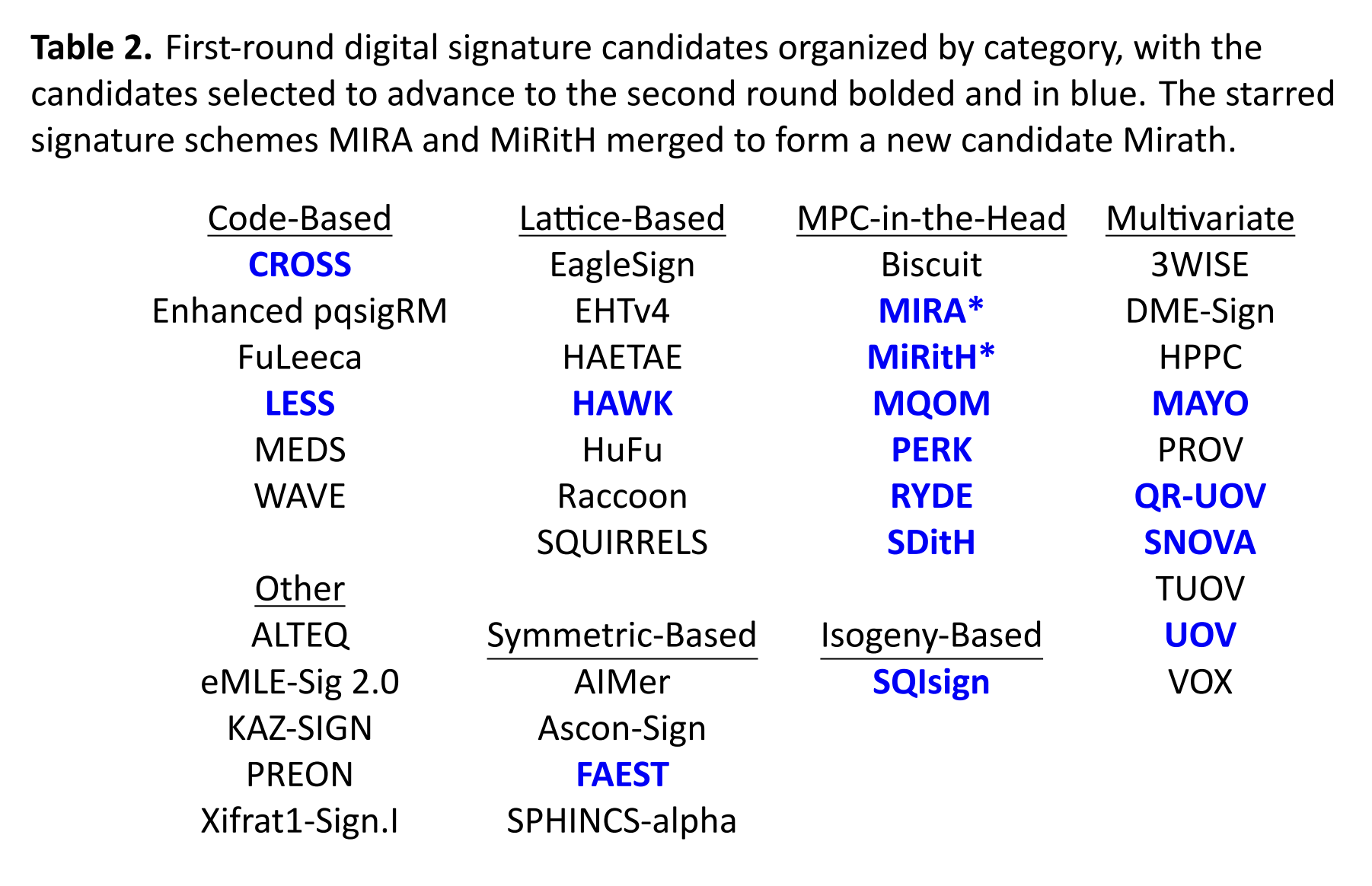
FAEST
See FAEST website for a full list of resources.
Notes:
- introduced in 20234
- based on AES128/192/256 and Vector Oblivious Linear Evaluation (VOLE) in the head (VOLEiTH)
- VOLEitH is constructed only from symmetric-key primitives
- NIST cites it as “somewhat complex” and says “the security proof is very technical.”2
Construction
\begin{align}
\pk &= (x,y)\\
\sk &= k
\end{align}
such that:
\begin{align}
E_k(x) = y,\ \text{where}\ E\ \text{is a block cipher}
\end{align}
Signing works by doing a ZKPoK of $k$ using VOLEitH and the QuickSilver information-theoretic proof system5 (under the Fiat-Shamir transform).
Sizes
Secret and public keys are small: 32 bytes at 128-bit security.
Signature sizes are described below.
Performance
Benchmarked on:
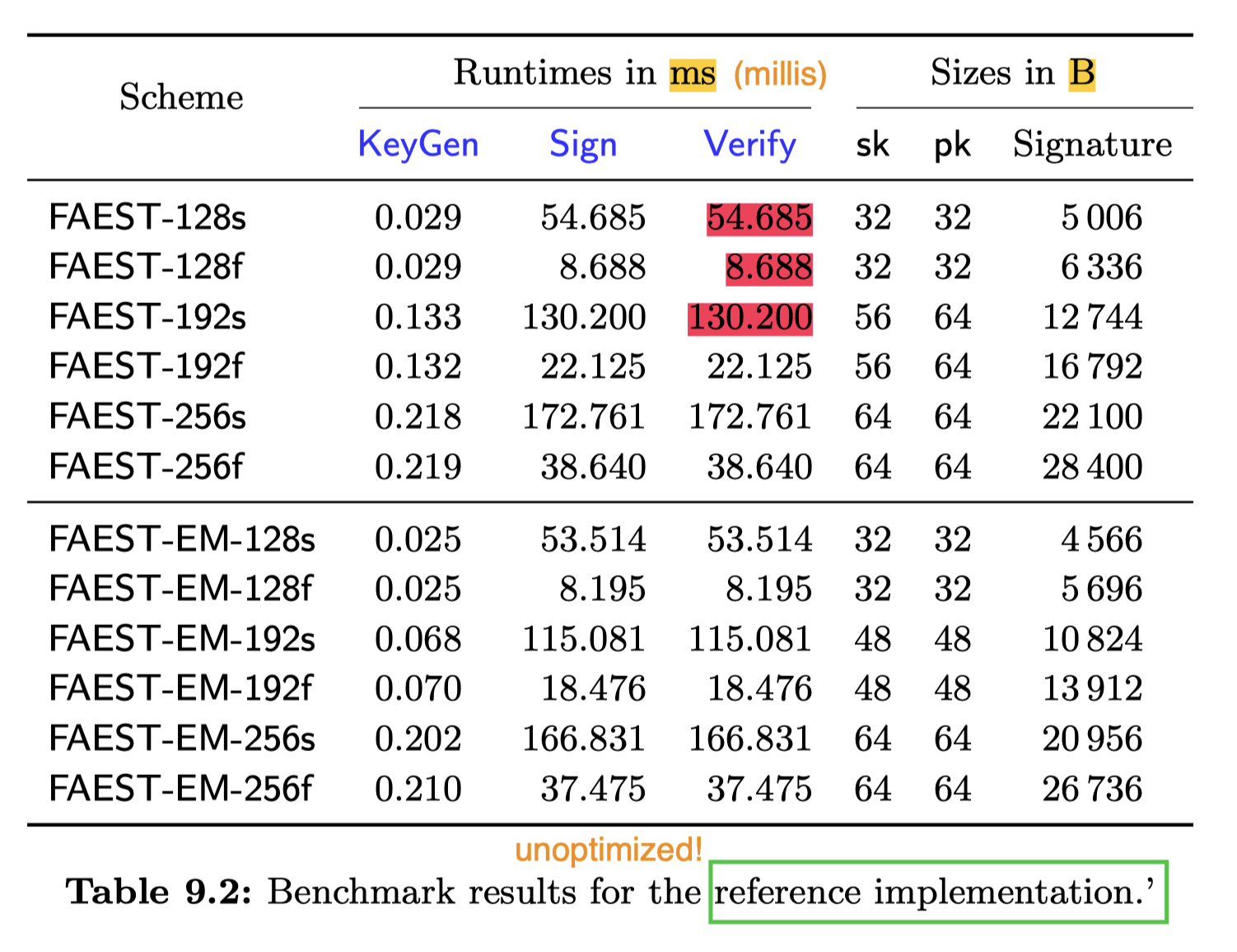
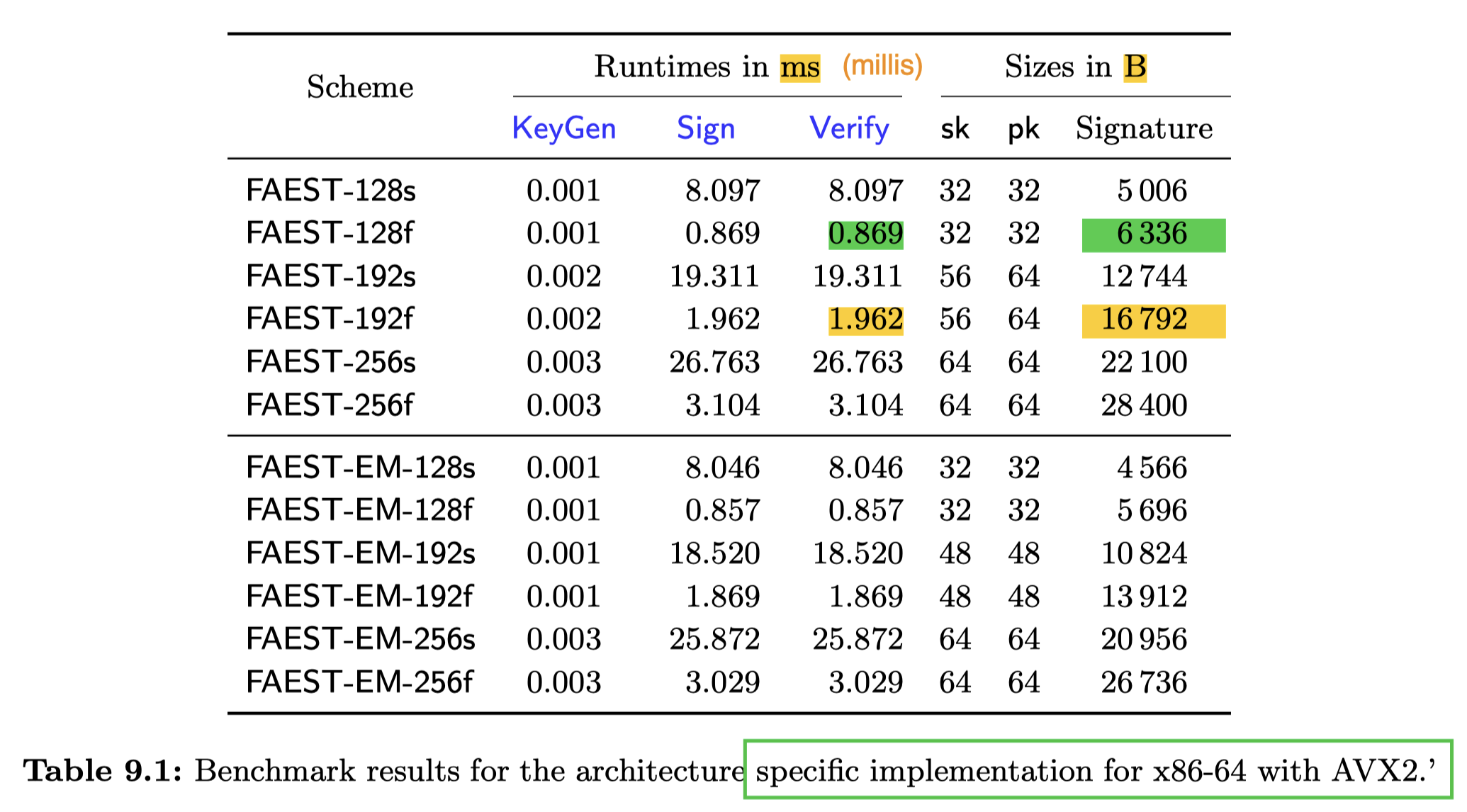
“a single core of a consumer notebook with an AMD Ryzen 7 5800H processor, with a base clock speed of 3.2 GHz and 16 GiB memory.” “Simultaneous Multi-Threading was enabled.” The computer was running Linux 6.1.30, and the implementations were built with GCC 12.2.1.”
Unoptimized reference implementation is too slow (tens of milliseconds to verify):
But x86-64 AVX2 implementation could be practical at 128-bit security level (0.87 ms to verify 6,336-byte signatures):
These numbers are multi-threaded!
Perhaps this recent QuickSilver improvement6 will help?
I quote: “For a circuit of size $\sizeof{C} = 2^{27}$, it shows up to 83.6× improvement on communication, compared to the general VOLE-ZK Quicksilver. In terms of running time, it is 70% faster when bandwidth is 10Mbps”.
Pratik Sarkar suggests it likely does not.
And even if it does, it would require additively-homomorphic encryption like BGV, which would introduce additional assumptions.
SLH-DSA (SPHINCS+)
See SPHINCS website for a full list of resources.
- FIPS-standardized7
- stateless, hash-based (hence the “SLH” acronym?)
- “an SLH-DSA key pair contains $2^{63}, 2^{64}, 2^{66}$, or $2^{68}$ forest of random subsets (FORS) keys”
- “FORS allows each key pair to safely sign a small number of messages”
- “An XMSS key consists of $2^{h’}$ WOTS$^+$ keys and can sign $2^{h’}$ messages”
- a rather-involved construction; would need to dig deeper to see if there’s a simple design underneath
- “The SHA2-based parameter sets are 2x slower than the SHAKE-based ones”
Construction
Key generation, at a high-level, works like this:
(sk_seed, sk_prf, pk_seed) ← random()
root ← build_merkle_tree(sk_seed, pk_seed)
SK = (sk_seed, sk_prf, pk_seed, root)
PK = (pk_seed, root)
So, in the context of blockchain accounts, the user’s mnemonic should be used to deterministically derive the pk_seed.
Otherwise, wallet recovery won’t work.
Sizes
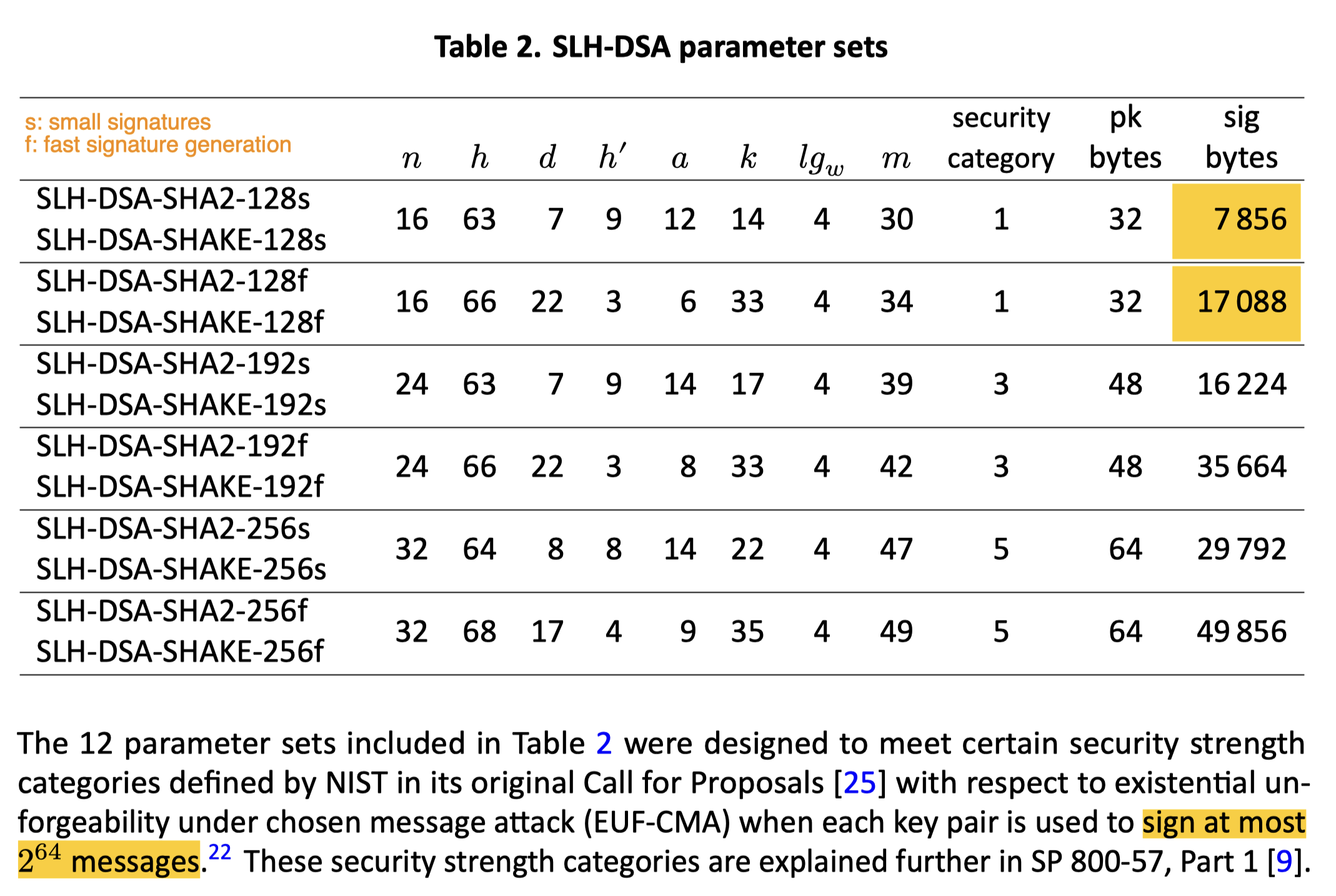
Key and signature sizes from FIPS-2057:
sphincs-shake-128f benchmarks
16.69 KiB signature size, signing time is 17 ms and verification is 1.1 ms!
Benchmarking the reference implementation in C8 on my Apple Macbook Pro, M1 Max below. They only provide an ARM implementation for the SHAKE variant $\Rightarrow$ not sure what the SHA2 numbers would look like on ARM.
Are these numbers single-threaded?
Got this kpc_get_thread_counters failed, run as sudo? error (I think) during the thash benchmarks.
Building this variant on ARM via:
git clone https://github.com/sphincs/sphincsplus/
cd shake-a64/
make clean
make benchmark
The results, edited for clarity of exposition:
cc -Wall -Wextra -Wpedantic -Wmissing-prototypes -O3 -std=c99 -fomit-frame-pointer -flto -DPARAMS=sphincs-shake-128f  -o test/benchmark test/cycles.c hash_shake.c hash_shakex2.c thash_shake_robustx2.c address.c randombytes.c merkle.c wots.c utils.c utilsx2.c fors.c sign.c fips202.c fips202x2.c f1600x2_const.c f1600x2.s test/benchmark.c
wrong fixed counters count

arameters: n = 16, h = 66, d = 22, b = 6, k = 33, w = 16

Running 10 iterations.

thash                avg.        0.53 us
f1600x2              avg.        0.28 us
thashx2              avg.        0.58 us

Generating keypair.. avg.     1,294.10 us
  - WOTS pk gen 2x.. avg.       294.70 us
Signing..            avg.    17,255.30 us --> 17 ms
  - FORS signing..   avg.       853.00 us
  - WOTS pk gen x2.. avg.       176.80 us
Verifying..          avg.     1,096.50 us --> 1.1 ms

Signature size: 17,088 bytes (16.69 KiB)

Public key size: 32 bytes (0.03 KiB)
Secret key size: 64 bytes (0.06 KiB)
sphincs-shake-128s benchmarks
Clear winner: hash-based, 7.67 KiB signatures created in 336 ms that verify in 0.4 ms!
Building this variant on ARM by via:
git clone https://github.com/sphincs/sphincsplus/
cd shake-a64/
gsed -i 's/shake-128f/shake-128s/g' Makefile
make clean
make benchmark
Note that the Makefile was modified to build the shorter s-variant of SPHINCS+.
The results for sphincs-shake-128s, edited for clarity of exposition:
cc -Wall -Wextra -Wpedantic -Wmissing-prototypes -O3 -std=c99 -fomit-frame-pointer -flto -DPARAMS=sphincs-shake-128s  -o test/benchmark test/cycles.c hash_shake.c hash_shakex2.c thash_shake_robustx2.c address.c randombytes.c merkle.c wots.c utils.c utilsx2.c fors.c sign.c fips202.c fips202x2.c f1600x2_const.c f1600x2.s test/benchmark.c
wrong fixed counters count
Parameters: n = 16, h = 63, d = 7, b = 12, k = 14, w = 16

Running 10 iterations.

thash                avg.        0.94 us
f1600x2              avg.        0.38 us
thashx2              avg.        0.66 us

Generating keypair.. avg.    46,510.80 us
  - WOTS pk gen 2x.. avg.       178.80 us
Signing..            avg.   336,702.20 us --> 336.7 ms
  - FORS signing..   avg.    22,816.50 us
  - WOTS pk gen x2.. avg.       176.40 us
Verifying..          avg.       396.10 us --> 0.396 ms

Signature size: 7,856 bytes (7.67 KiB)

Public key size: 32 bytes (0.03 KiB)
Secret key size: 64 bytes (0.06 KiB)
Performance of RustCrypto/signatures
Seems like a single-threaded implementation.
Bechmarked via:
git clone https://github.com/RustCrypto/signatures
cd slh-dsa/
cargo bench
SHA2 variants are faster. It may be because they leverage native SHA2 instructions.
| Scheme | Signing Time | Verification Time | Sig. size (bytes) |
|---|---|---|---|
| SLH-DSA-SHAKE-128s | 1.06 s | 0.98 ms | 7,856 |
| SLH-DSA-SHAKE-192s | 1.81 s | 1.46 ms | 16,224 |
| SLH-DSA-SHAKE-256s | 1.58 s | 2.11 ms | 29,792 |
| SLH-DSA-SHAKE-128f | 50.29 ms | 3.14 ms | 17,088 |
| SLH-DSA-SHAKE-192f | 81.56 ms | 4.35 ms | 35,664 |
| SLH-DSA-SHAKE-256f | 166.38 ms | 4.59 ms | 49,856 |
| SLH-DSA-SHA2-128s | 137.45 ms | 144.93 µs | same |
| SLH-DSA-SHA2-192s | 285.07 ms | 232.93 µs | same |
| SLH-DSA-SHA2-256s | 254.05 ms | 340.57 µs | same |
| SLH-DSA-SHA2-128f | 6.61 ms | 439.25 µs | same |
| SLH-DSA-SHA2-192f | 12.38 ms | 661.47 µs | same |
| SLH-DSA-SHA2-256f | 24.27 ms | 673.78 µs | same |
TODO
Falcon
See this post by Antonio Sanso.
SIS-based schemes
GPV hash-and-sign signatures and their plain-lattice descendants9. (Also see this.) “Fiat-Shamir with Aborts” signatures10$,$11. Squirrels. HuFu. (Also see this survey.)
ML-DSA
Investigate ML-DSA, based on MLWE.
| Private Key | Public Key | Signature Size | |
|---|---|---|---|
| ML-DSA-44 | 2,560 | 1,312 | 2,420 |
| ML-DSA-65 | 4,032 | 1,952 | 3,309 |
| ML-DSA-87 | 4,896 | 2,592 | 4,627 |
Others
HAWK.
References
For cited works, see below 👇👇
-
Post-Quantum Cryptography: Additional Digital Signature Schemes (Round 2) ↩
-
Status Report on the First Round of the Additional Digital Signature Schemes for the NIST Post-Quantum Cryptography Standardization Process, by Gorjan Alagic and Maxime Bros and Pierre Ciadoux and David Cooper and Quynh Dang and Thinh Dang and John Kelsey and Jacob Lichtinger and Yi-Kai Liu and Carl Miller and Dustin Moody and Rene Peralta and Ray Perlner and Angela Robinson and Hamilton Silberg and Daniel Smith-Tone and Noah Waller, 2024, [URL] ↩ ↩2
-
FAEST: Algorithm Specifications (Version 1.0), by Carsten Baum and Lennart Braun and Cyprien Delpech de Saint Guilhem and Michael Klooß and Christian Majenz and Shibam Mukherjee and Sebastian Ramacher and Christian Rechberger and Emmanuela Orsini and Lawrence Roy and Peter Scholl, 2023, [URL] ↩
-
QuickSilver}: Efficient and Affordable Zero-Knowledge Proofs for Circuits and Polynomials over Any Field, by Kang Yang and Pratik Sarkar and Chenkai Weng and Xiao Wang, in Cryptology {ePrint} Archive, Paper 2021/076, 2021, [URL] ↩
-
An Efficient {ZK} Compiler from {SIMD} Circuits to General Circuits, by Dung Bui and Haotian Chu and Geoffroy Couteau and Xiao Wang and Chenkai Weng and Kang Yang and Yu Yu, in Cryptology {ePrint} Archive, Paper 2023/1610, 2023, [URL] ↩
-
FIPS 205: Stateless Hash-Based Digital Signature Standard, by National Institute of Standards and Technology (NIST), 2024, [URL] ↩ ↩2
-
Trapdoors for Hard Lattices and New Cryptographic Constructions, by Craig Gentry and Chris Peikert and Vinod Vaikuntanathan, in Cryptology {ePrint} Archive, Paper 2007/432, 2007, [URL] ↩
-
Fiat-Shamir with Aborts: Applications to Lattice and Factoring-Based Signatures, by Lyubashevsky, Vadim, in Advances in Cryptology – ASIACRYPT 2009, 2009 ↩
-
Lattice Signatures without Trapdoors, by Lyubashevsky, Vadim, in Advances in Cryptology – EUROCRYPT 2012, 2012 ↩